

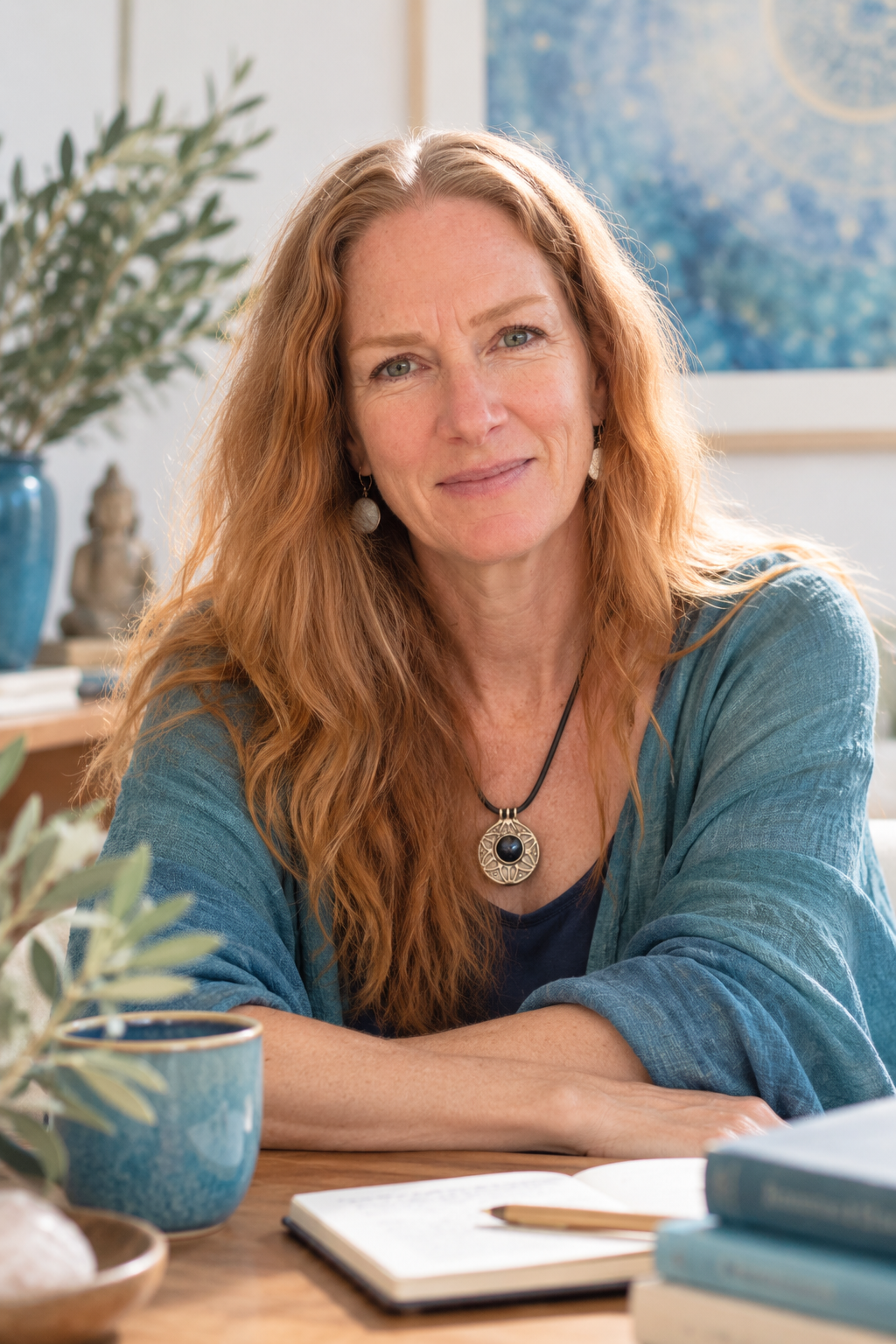
The work we offer others is often shaped by the questions we have lived ourselves.
For more than three decades, my work has centred on a question that continues to fascinate me:
What actually allows human beings to change — not simply in what we understand, but in the way we live, relate and inhabit ourselves?
That question has taken me through counselling and mental health, clinical practice, education and supervision, embodied approaches to transformation, contemplative practice and the exploration of consciousness and sprituality.
At first, these seemed like different worlds.
Over time, I came to understand that they were different ways of approaching the same territory.
The territory of being human.
ABOUT FIONA CLARE
A LIFE SPENT EXPLORING TRANSFORMATION
My professional foundations are in social work, counselling and mental health.
Over more than thirty years, I have worked across child and adolescent mental health, suicide prevention, primary mental health care, perinatal and infant mental health, counselling, clinical supervision and university education.
I trained extensively in cognitive behavioural approaches and mindfulness-based practice, and over time became interested in a much wider range of relational, somatic, interpersonal and transpersonal approaches.
Today, alongside my work through Fiona Clare, I am a university lecturer in Adelaide, where I teach counselling practice and clinical supervision, and support students as they develop their own ways of working with people.
These different roles have given me many ways of thinking about change — and just as importantly, many opportunities to sit alongside people while change is actually happening.
One of the things I have come to understand is that knowing why we do something does not necessarily mean we are able to do something differently.
We can have considerable insight into our patterns, understand where they came from, and still find ourselves returning to them.
That gap between understanding something and actually being able to live it differently became increasingly interesting to me.
WHEN UNDERSTANDING BECOMES EMBODIED
Over the years, my exploration moved increasingly toward the body, nervous system, contemplative practice and consciousness.
I became interested in what happens beneath the story.
How does the body learn safety?
Why can we recognise a familiar pattern and still find ourselves returning to it?
What allows something we understand intellectually to become something we can actually inhabit?
And what happens when we develop enough internal stability to remain present with experiences, perceptions and possibilities that once felt overwhelming or inaccessible?
These questions gradually changed the way I understood transformation.
I began to see it less as a process of fixing ourselves and more as a process of developing capacity.
The capacity to stay.
To feel.
To discern.
To hold complexity.
To remain connected with ourselves while something new is emerging.
STARGATE BLUEPRINT
Eventually, the pieces began to form an architecture.
Stargate Blueprint emerged from the intersection of these different streams of my life and work.
Psychology gave me ways of understanding pattern and adaptation.
Embodied practice taught me to listen to what the body knows.
Contemplative and spiritual inquiry opened questions about consciousness, meaning and the nature of human experience.
And decades of sitting beside people in moments of vulnerability, transition and change taught me something perhaps more important:
Transformation cannot be imposed from the outside.
We can create conditions for it. We can develop capacities that support it. We can learn to recognise the patterns that keep returning.
But ultimately, transformation becomes real when it is lived from within.
Stargate Blueprint is my attempt to give form to that understanding — a developmental architecture for exploring how we become increasingly able to inhabit ourselves through change.
The way I work.
I don't see my role as telling you who you should become.
Nor am I interested in offering another idealised version of yourself to strive toward.
I am interested in creating spaces where you can become more curious about what is already here — the patterns and strategies that have shaped you, the capacities that are developing, the places where you lose connection with yourself, and what may be beginning to emerge.
I think of this as a kind of living laboratory.
A space where we can be curious. Where ideas can be explored, practices experienced, and we can notice what actually makes a difference when something is lived.
This is also how I have approached my own learning and development. I draw from psychology, counselling, embodied practice, contemplative traditions and spiritual inquiry — not because any one of them holds the whole answer, but because each offers a different way of understanding the complexity of being human.
Some things have stayed with me. Others haven't.
What matters to me is what happens when an idea is lived.
Does it help us become more present? More able to stay with ourselves? More able to recognise our patterns without being governed by them? Does it create greater choice?
There is room in my work for intellect and intuition.
For science and mystery.
For the nervous system and the symbolic.
For what we can explain — and for what we are still learning how to understand.
We do not have to transcend our humanity in order to transform.
Perhaps the invitation is to inhabit it more fully.
-
Psychology gives us ways of understanding the patterns, relationships and experiences that shape how we meet ourselves and the world. It offers a language for becoming curious about what we do — and why.
-
Understanding something is not the same as being able to live it. Embodied practice brings our attention to what is happening in the body and nervous system, and helps new ways of responding become something we can actually experience.
-
I am interested in the questions that sit beyond what we can easily explain — questions of meaning, awareness, intuition and consciousness. I hold these as areas for exploration rather than fixed truths.
-
Ultimately, our lives are where the work is tested. What matters is not how compelling an idea sounds, but whether it helps us meet ourselves, our relationships and the realities of our lives with greater presence and choice.
Curious about working together?
Explore the different ways we can journey together.
My Philosophy of Practice
We are not problems to be solved.
We are living, relational beings — continually adapting, learning and becoming.
As we cultivate greater awareness, coherence and embodied presence, we open new possibilities for how we relate, choose, create and participate in the world.
Transformation begins within us, but it does not end there.
Fiona is an accredited social worker, counsellor, clinical supervisor and university educator with more than 30 years' experience across mental health, counselling and professional education.
Qualifications + Professional Recognition
Bachelor of Social Work
Master of Mental Health Sciences (CBT)
Graduate Diploma in Public Health (Indigenous Health)
AASW Accredited Social Worker
AASW Accredited Clinical Supervisor
Senior Lecturer in Behavioural Health & Counselling, Flinders University
Diploma Management
Certificate in Somatic Therapies
Additional training and practice experience spans cognitive behavioural and mindfulness-based approaches, group work, relational and somatic practices, and interpersonal and transpersonal approaches to human development.
Professional Background
My wider training and personal practice has also taken me into energy-based, transpersonal and esoteric approaches to healing and transformation. These have been part of my ongoing exploration of embodiment, awareness, consciousness and the many ways we experience change.
Additional Training & Practice:
Isis Seichem
Theta Healing
Munay Ki
Soul Regression Therapy
Emotional Freedom Technique
Light Body Activation (Selenite Tools of Light)
Wu Tao (healing dance)
My personal practice has also included meditation, yoga, sound healing and breathwork, alongside many years of facilitating women's circles, workshops and retreats.